
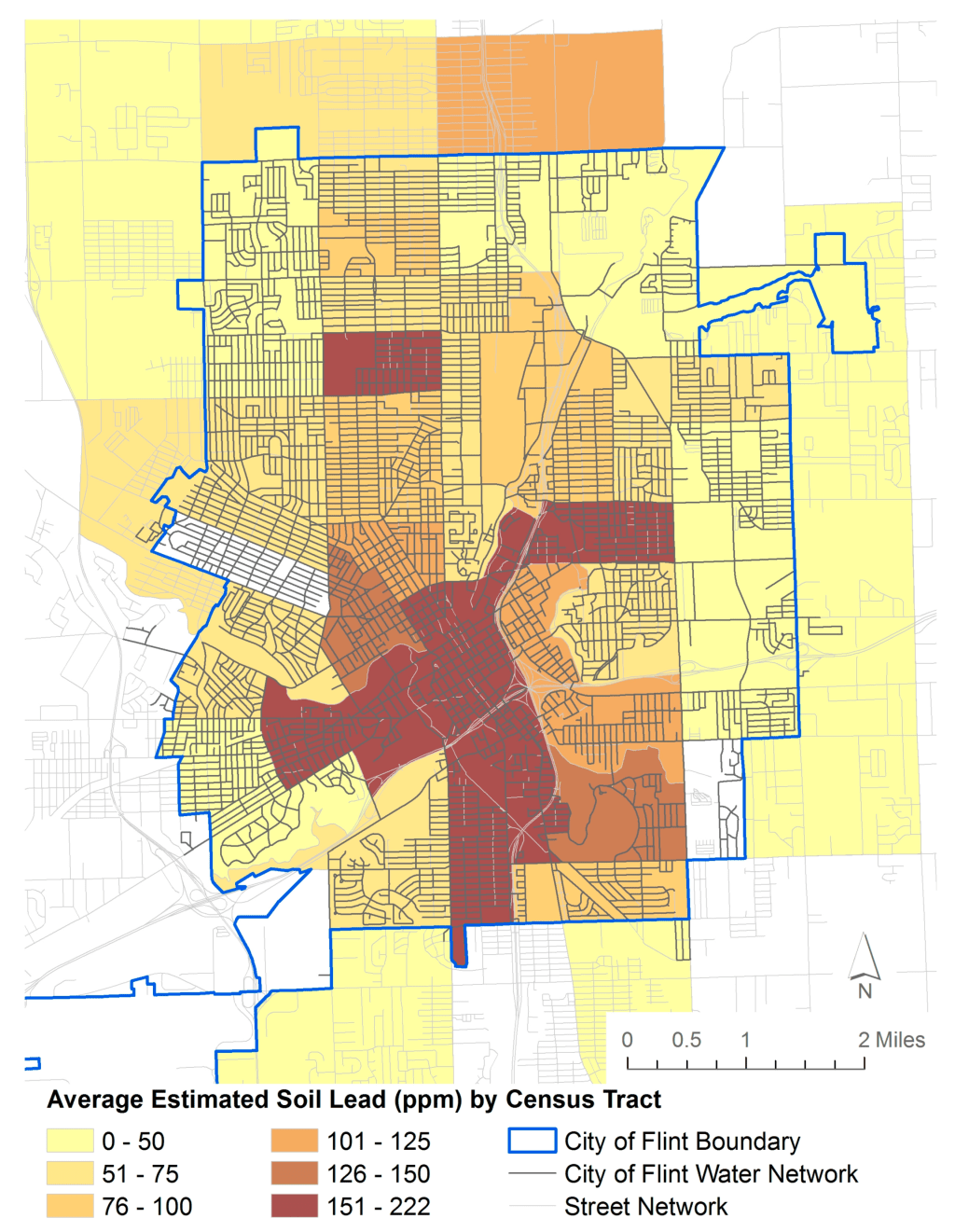
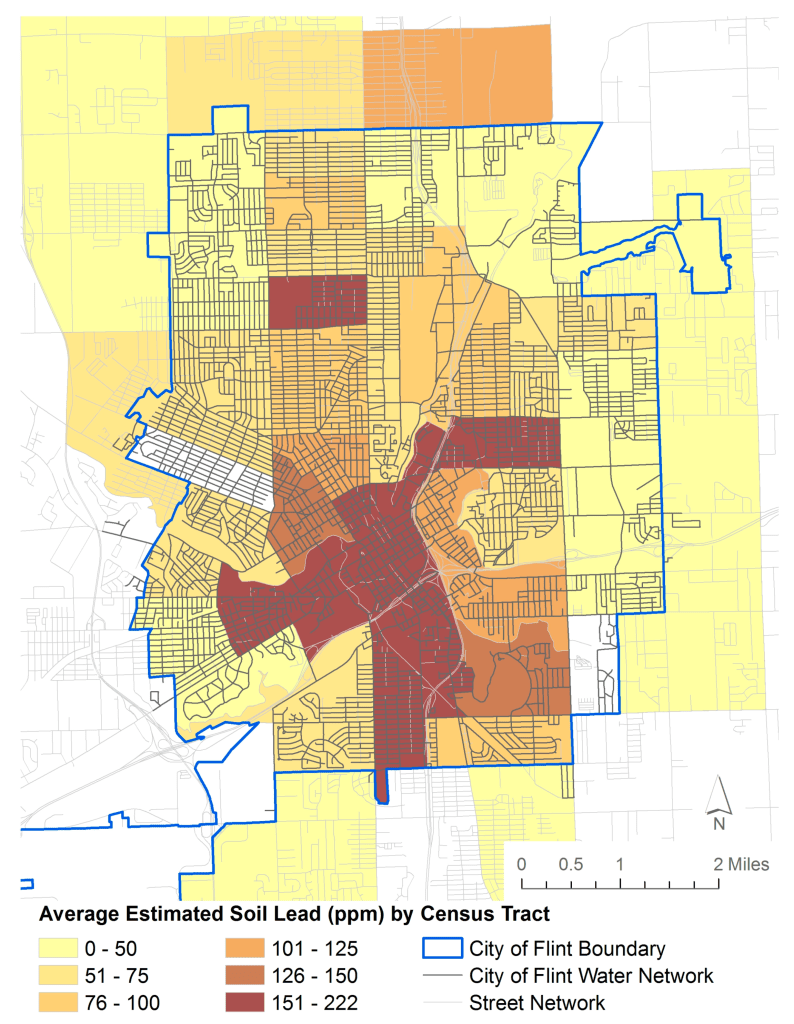
This map comes from an academic article published in the International Journal of Environmental Research and Public Health (IJERPH) by local Dr. Sadler from MSU and researchers from RMIT in Australia, IUPUI in Indiana, and Tulane University in Louisiana. A common concern with child lead exposure is the existence of lead dust that enters the air from the dirt (lead re-suspension), which is most common during summer high temperatures.
This paper integrates bulk composite soil samples previously collected by the Edible Flint local food collaborative throughout the city from 2011 to 2015. Each sample was collected at the start of the spring growing season (typically in the second quarter) from 10 to 15 randomly selected sites at personal residences and community gardens, exclusively in residential neighborhoods. Edible Flint staff and volunteers conducting the sampling were trained to use the Michigan State University soil test protocol, which included: sampling from untilled soils at a depth of 3–4 inches for lawns and 7 inches for gardens, using a metal or plastic hand spade to collect samples, and storing samples in Ziploc or plastic bags. A total of 248 samples were collected.


Leave a Reply